 |
416th Bombardment Group (L) Mission # 259 -- March 31, 1945, Saturday PM Marienburg, Germany Storage Area
|
 |
Previous Mission # 258 Mission List Next Mission # 260 Return to Table of Contents
|
416th Bombardment Group (L) Mission # 259 -- March 31, 1945, Saturday PM Marienburg, Germany Storage Area
|
|
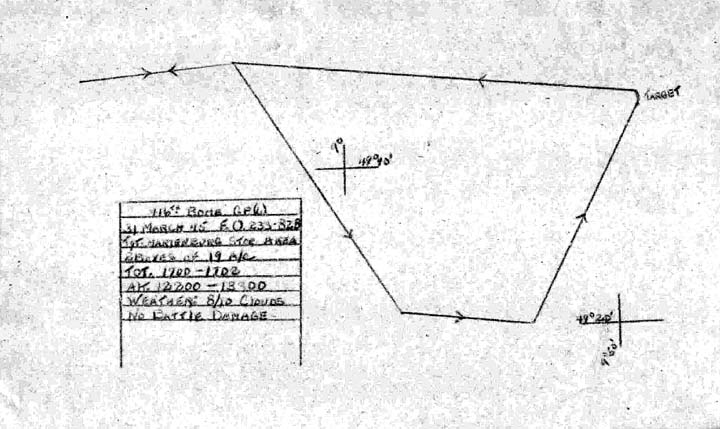
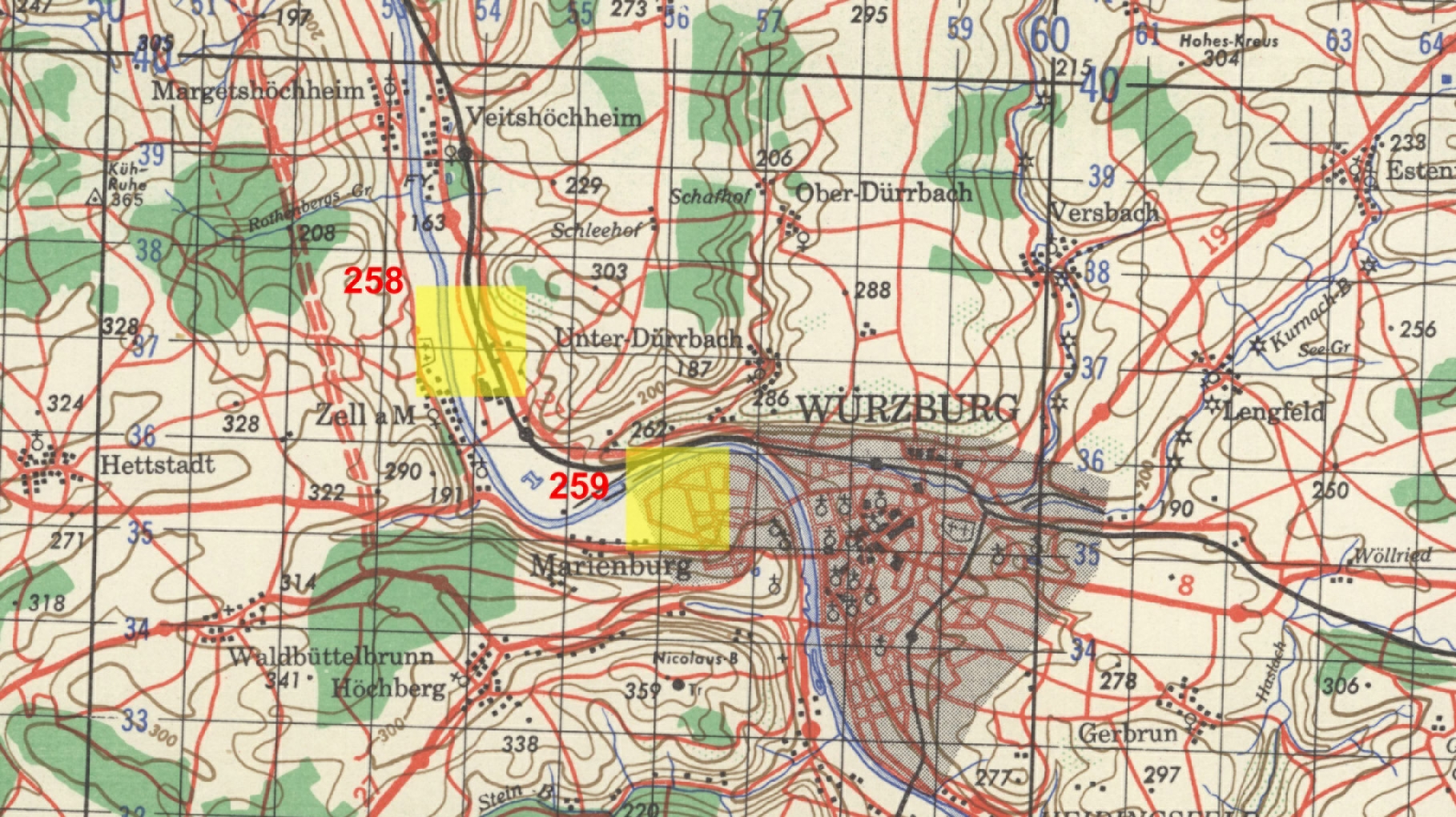
Place of Take-Off : A-69 Laon/Athies, France A/C Dispatched : 40 Total -- 38 A-26's, 2 B-26's (PFF) Modified British System Reference: N-562355 Secondary Target : Ebenhausen Oil Storage Depot Summary of Results : Unobserved. Primary Target Latitude/Longitude: 49.79915,9.90886 (49° 47' 57" N, 9° 54' 32" E) (Latitude/Longitude based on The "Coordinates Translator", (NGZ) wN562355) (See Latitude/Longitude Coordinates and Target Identifiers for more information. Note: This coordinate represents the Primary Target Location, the Location actually attacked may differ) |
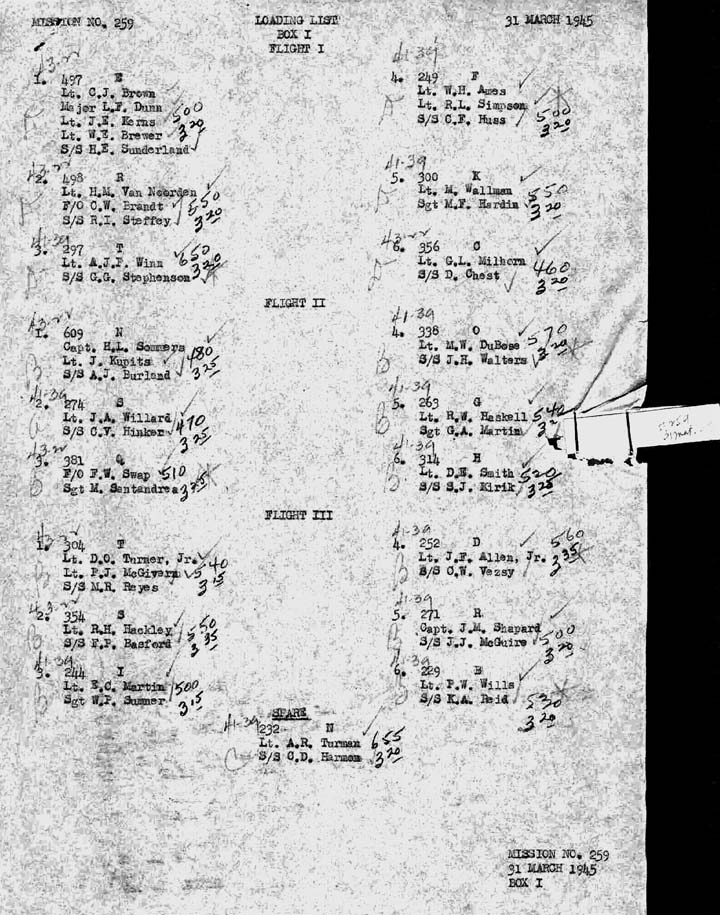
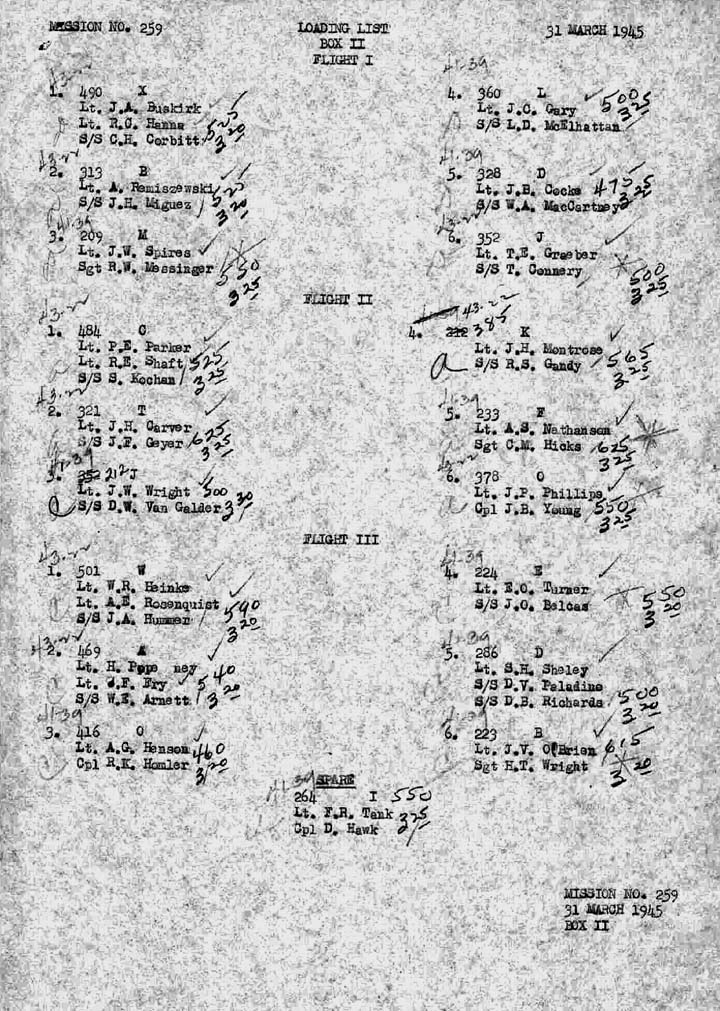
Mission Loading Lists Transcription
Mission # 259 -- March 31, 1945, Saturday PM
Marienburg, Germany -- Storage Area
| 1 671st 43-22497 5C-E A-26C Lt Brown, C.J. Lt Kerns, J.E. Lt Brewer, W.E., Sr. S/Sgt Sunderland, H.E. Maj Dunn, L.F. |
2 671st 43-22498 5C-R A-26C Lt VanNoorden, H.M. F/O Brandt, C.W. S/Sgt Steffey, R.I. |
3 671st 41-39297 5C-T A-26B Lt Winn, A.J.P. S/Sgt Stephenson, G.G. |
| 4 671st 41-39249 5C-F A-26B Lt Ames, W.H. Lt Simpson, R.L. S/Sgt Huss, C.F. |
5 671st 41-39300 5C-K A-26B Lt Wallman, M. Sgt Hardin, M.F. |
6 671st 43-22356 5C-C A-26B Lt Milhorn, G.L. S/Sgt Chest, D. |
| 1 669th 43-22609 2A-N A-26C Capt Sommers, H.L. Lt Kupits, J. S/Sgt Burland, A.J. |
2 668th 41-39274 5H-S A-26B Lt Willard, J.A. S/Sgt Hinker, C.V. |
3 669th 43-22381 2A-Q A-26B F/O Swap, F.W. Sgt Santandrea, M. |
| 4 669th 41-39338 2A-O A-26B Lt DuBose, M.W. S/Sgt Walters, J.H. |
5 669th 41-39263 2A-G A-26B Lt Haskell, R.W. Sgt Martin, G.A. |
6 669th 41-39314 2A-H A-26B Lt Smith, D.E. S/Sgt Kirik, S.J. |
| 1 669th 43-22304 2A-T A-26C Lt Turner, D.O., Jr. Lt McGivern, P.J. S/Sgt Reyes, M.R. |
2 669th 43-22354 2A-S A-26B Lt Hackley, R.H. S/Sgt Basford, F.P. |
3 669th 41-39244 2A-I A-26B Lt Martin, E.C. Sgt Sumner, W.R., Jr. |
| 4 669th 41-39252 2A-D A-26B Lt Allen, J.F., Jr. S/Sgt Veazey, C.W. |
5 669th 41-39271 2A-R A-26B Capt Shapard, J.M. S/Sgt McGuire, J.J. |
6 669th 41-39229 2A-B A-26B Lt Wills, P.W. S/Sgt Reid, K.A. |
| SPARE 670th 41-39232 F6-N A-26B Lt Turman, A.R. S/Sgt Harmon, C.D. |
| 1 671st 43-22490 5C-X A-26C Lt Buskirk, J.A. Lt Hanna, R.C. S/Sgt Corbitt, C.H., Jr. |
2 671st 43-22313 5C-B A-26B Lt Remiszewski, A. S/Sgt Miguez, J.H. |
3 671st 41-39209 5C-M A-26B Lt Spires, J.W. Sgt Messinger, R.W. |
| 4 671st 41-39360 5C-L A-26B Lt Gary, J.C. S/Sgt McElhattan, L.D. |
5 671st 41-39328 5C-D A-26B Lt Cocke, J.B. S/Sgt MacCartney, W.A. |
6 671st 43-22352 5C-J A-26B Lt Graeber, T.E. S/Sgt Connery, T.F. |
| 1 668th 43-22484 5H-C A-26C Lt Parker, P.E. Lt Shaft, R.E. S/Sgt Kochan, S.J. |
2 668th 43-22321 5H-T A-26B Lt Carver, J.H. S/Sgt Geyer, J.F. |
3 670th 41-39212 F6-K A-26B Lt Wright, J.W. S/Sgt VanGalder, D.W. |
| 4 668th 43-22385 5H-D A-26B Lt Montrose, J.H. S/Sgt Gandy, R.S. |
5 668th 41-39233 5H-F A-26B Lt Nathanson, A.S. Sgt Hicks, C.M. |
6 668th 43-22378 5H-O A-26B Lt Phillips, J.P. Cpl Young, J.B. |
| 1 670th 43-22501 F6-W A-26C Lt Heinke, W.R. Lt Rosenquist, A.E. S/Sgt Hummer, J.A. |
2 670th 43-22469 F6-A A-26C Lt Popeney, H.V. Lt Fry, C.F. S/Sgt Arnett, W.E. |
3 670th 41-39416 F6-O A-26B Lt Henson, A.G. Cpl Homler, R.K. |
| 4 670th 41-39224 F6-E A-26B Lt Turner, E.O. S/Sgt Belcas, J.O. |
5 670th 41-39286 F6-D A-26B Lt Sheley, S.H. S/Sgt Paladino, D.V. S/Sgt Richards, D.B. |
6 670th 41-39223 F6-B A-26B Lt O'Brien, J.V. Sgt Wright, H.T. |
| SPARE 668th 41-39264 5H-I A-26B Lt Tank, F.R. Cpl Hawk, D.W. |
Group and Unit Histories
Mission # 259 -- March 31, 1945, Saturday PM
Marienburg, Germany -- Storage Area
"416th Bombardment Group (L) - Group History 1945"
Transcribed from USAF Archives
Mission # 259, the forty-second mission of the month, took off in the afternoon. It was an uneventful PPF attack on the Marienburg storage area, just south of Wurzburg. A few crews reported hits in the target area. The first box leader was Lt. Brown, Lts. Kerns and Brewer, B&N; Lt. Buskirk, Lt. Hanna, B-N, led the second box. It was the last mission of the month of March.
In our first full year of operations, ending 2 March 1945, our Group flew 219 missions, including 7,486 individual sorties, dropping 6394 1/2 tons of bombs. However, during the month of March 1945, our Group flew 1615 sorties on 42 missions and dropped a total of 2565 3/4 tons of bombs, a bit more than 40% of the total tonnage dropped during the first year of operations, although we had flown only one-fifth as many missions. During that first year of operations 72 aircraft were lost, either over enemy or friendly territory, due to enemy action, or .96% of the total number of sorties flown.
"Attack Bombers, We Need You! A History of the 416th Bomb Group"
Ralph Conte
Page 243
Mission #259 - 31 March - PM - Marianburg Storage Area.
This mission was determined to be an uneventful attack, with
PFF Pathfinders leading the formation in. A few crews reported
hits on the target area. Box I reported excellent results. Lt.
Brown and Lts Kerns and Brewer, BNs with Lt. Buskirk and
Hanna BN, led boxes. Lt. Van Noorden with F/O Brandt BN and
Lt. Ames with Lt. Simpson BN led flights.
The 416th flew 42 missions in March, dropping 2565
tons of bombs, a bit more than 40 percent of the total tonnage
dropped during the first year of operation, although we had
flown only one-fifth as many missions. This increase in tonnage
is certainly attributable to the heavier bomb load carried by the
A-26s as compared to that amount the A-20s would carry. In the
first full year of operation, to March 2, 1945, our Group flew 219
missions, including 7486 individual sorties, dropping 6394 tons
of bombs. During March 1945 our group flew 1615 sorties.
During the first year of operation, 72 aircraft were lost either
over enemy territory or friendly area, due to enemy action, or 0.9
percent of the total number of sorties flown. The 416th were a
major influence in assisting ground forces in their advances
toward German forces and encampments, destroying bridges and
marshalling yards, plus ammo depots. We were called upon often
for support of our allied forces. It was a rewarding experience,
with most of the flights being conducted by other than the original
crews which came over in January 1944. The newer crews
were eminently successful.
Ninth Bomb Division Has Record Month
Commended by Lieutenant General Omar F. Bradley for
its sustained offensive, the 9th Bomb Division turned out a
record month of operations during which its medium and light
bombers flew 15,000 sorties and dropped 24,000 tons of bombs.
The March figures set an all time high for Major General
Samuel E. Anderson's bomber forces, eclipsing the previous
record of 10,538 sorties and 15,226 tons established in June
1944.
Operational 28 days, including 19 straight days from
March 8 through March 26, the division's B-26s, A-20s and A-26s
ranged over a 250 mile front from Munster Bay south to the
Main Scarplanes to disrupt road and rail communications and
deny the Germans facilities for moving reinforcements equipment
and supplies to meet current Allied offensives.
Two-thirds of the division's record assault was directed
against communications centers, marshalling yards, and bridges
on routes feeding battle areas with supplies and reinforcements.
Sweeping advances by ground forces over the entire western
front testify to the bombers' success in blocking German
attempts to strengthen defense lines. Successfully completed
campaigns to isolate battle areas, including the Ruhr and
Remagen bridgehead, resulted in wide-spread destruction to
German transportation facilities. Nine major railroad bridges on
main lines were destroyed or left unserviceable, four railroad
overpasses damaged and at least 33 marshalling yards severely
damaged. Bomber attacks cut all lines in 20 rail yards and left
only one line open in eight others. A total of 584 rail cuts were
made.
Rail facilities destroyed or damaged included 1,769 cars,
nine roundhouses, 12 locomotives and 26 workshops.
Sharing top priority with rail targets in the bombers' March
offensive were 81 communications centers, equally important to
Germans' defense in the west. Attacking the towns with 8,000
tons of incendiaries and high explosives, the medium and light
bombers blocked roads with craters and debris, cut rail lines and
leveled warehouses, factories and buildings that would offer protection
for house-to-house fighting.
Destroyed or damaged in the bombers' assault on communications
centers were 7,851 buildings, 79 factories and 99
warehouses. Main and secondary roads running through the town
were cut in 887 places, two highway overpasses destroyed and
six highway bridges damaged.
A four day offensive against gun positions, roads and rail
lines in and around 21 towns in the area north of the Ruhr where
the 21st Army Group now is expanding its Rhine River bridgehead
highlighted the bombers attacks on communications centers.
While main weight of their attacks were aimed at road
and rail facilities, the bombers backed up their assault to immobilize
the German Army by striking at seven fuel and ammunition
dumps and 10 ordnance and motor vehicle repair depots.
Twenty-three bombers were lost to flak and enemy fighters
during the month, against claims of nine enemy fighters
destroyed, three probably destroyed and five damaged.
"669th Bombardment Squadron (L) History"
Transcription from USAF Archives
To end an extremely busy month, two more operational missions were flown on the 31st. The Wurzburg Storage Depot was attacked by the use of PPF equipment by the first box. The second box made a visual run and obtained very good results. Capt. Miller, with Lt. Conner and Flight Officer Wrubelle led the first box. Lt. Col. Napier, and his B/N Lt. Moore led the second box.
Mission # 259 was the last mission flown during the month. The Marienburg Storage Area was bombed. PPF aircraft led the formation on the bombing run. Cloud cover made a visual run impossible. Capt. Sommers with Lt. Kupits flew in the lead position of the second flight of the first box. Lt. Turner with his B/N, Lt. McGivern, was the flight leader of the third flight of the first box. Bombs were seen to hit the target area.
"670th Bombardment Squadron (L) History"
Transcription from USAF Archives
Two missions were run on the 31st of March. One was against the Wurzburg Storage Depot and the other against the Marionburg Storage area. Again bad weather made observation of results impossible. A total of fourteen crews took part in these two missions.
"671st Bomb Squadron (L) Unit History"
Gordon Russell and Jim Kerns
March 31st, 1945
The "Fighting; Flying, F _ _ _ _ _ _", 416th Bomb Group rounded out its most active month of Operations on March 31st, chalking up mission number 41 and 42 for the month. Ground forces moving toward Wurzburg received a valuable assist from the 416th in the morning as the Invaders struck by PFF at a large storage depot in the city. Crews reported good to excellent results on visual observation. The 500-pound incendiary clusters started large fires in the block of warehouse buildings. Wurzburg is situated on the main line between Frankfurt and Nurnberg. Weak flak was encountered in the target area and four ships received battle damage. All crews returned.
To further deplete the enemy's supplies the 416th Group and five other 9th Bomb Division Groups struck at a storage area in Marienburg, across the Main River from Wurzburg. The vast storage area comprises 21 warehouse type and 20 smaller buildings, a permanent barracks area and a large motor park. American tanks and infantry were reported meeting resistance in this area and crews were told that if the enemy was to counter-attack it probably would be from that point. Box I obtained excellent results on the PFF lead, but the pathfinder aircraft of the second box dropped late. There were no losses, casualties or battle damages.

|
[March 31, 1945], HQ Twelfth Army Group situation map Map showing Western Allies and Axis troop position details in Western Europe as of approximately 1200 hours, March 31, 1945 World War II Military Situation Maps Collection Library of Congress |