 |
416th Bombardment Group (L) Mission # 190 -- January 22, 1945, Monday PM Dasburg, Luxembourg Road Convoy
|
 |
Previous Mission # 189 Mission List Next Mission # 191 Return to Table of Contents
|
416th Bombardment Group (L) Mission # 190 -- January 22, 1945, Monday PM Dasburg, Luxembourg Road Convoy
|
|
Place of Take-Off : A-55 Melun/Villaroche, France A/C Dispatched : 6 Total -- 6 A-26's Target Ref : ROAD CONVOY Summary of Results : Strafing mission. No Attack - Abandoned operation at 1712 as ordered by Parade. Primary Target Latitude/Longitude: 49.61667,6.13333 (49° 37' 0" N, 6° 7' 60" E) (Latitude/Longitude based on F/O Lat/Lon, F/O Lat/Lon) (See Latitude/Longitude Coordinates and Target Identifiers for more information. Note: This coordinate represents the Primary Target Location, the Location actually attacked may differ) |
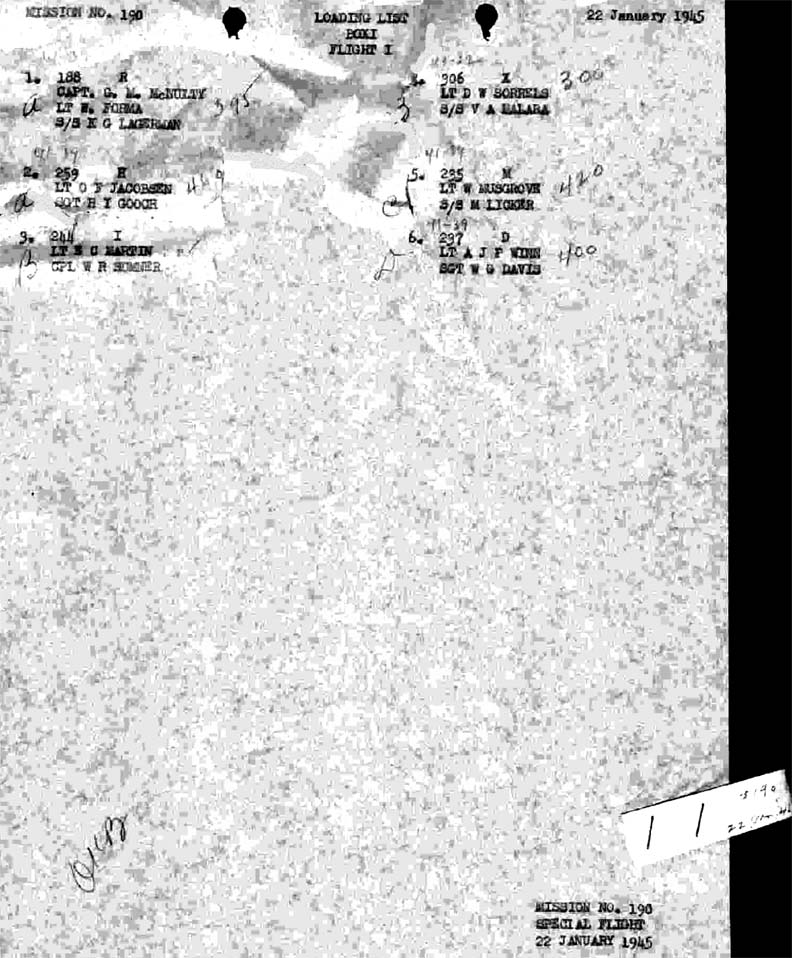
Mission Loading Lists Transcription
Mission # 190 -- January 22, 1945, Monday PM
Dasburg, Luxembourg -- Road Convoy
| 1 668th 41-39188 5H-R A-26B Capt McNulty, G.M. Lt Forma, W. S/Sgt Lagerman, K.G. |
2 668th 41-39259 5H-H A-26B Lt Jacobsen, O.F. Sgt Gooch, H.I. |
3 669th 41-39244 2A-I A-26B Lt Martin, E.C. Cpl Sumner, W.R., Jr. |
| 4 669th 43-22306 2A-X A-26B Lt Sorrels, D.W. S/Sgt Malara, V.A. |
5 670th 41-39235 F6-M A-26B Lt Musgrove, W. S/Sgt Licker, M. |
6 671st 41-39237 5C-D A-26B Lt Winn, A.J.P. Sgt Davis, W.G., Jr. |
Group and Unit Histories
Mission # 190 -- January 22, 1945, Monday PM
Dasburg, Luxembourg -- Road Convoy
"416th Bombardment Group (L) - Group History 1945"
Transcribed from USAF Archives
Late that afternoon, six A-26 planes took off on a special strafing attack on road convoys, led by Capt McNulty, Lt Forma, B-N. No bombs were carried, but full loads of ammunition were ready for use. The bombers were late at their fighter rendezvous, but continued on over enemy territory until they were recalled by Parade without making an attack. Weather further hindered any attack even without fighter escort.
"Attack Bombers, We Need You! A History of the 416th Bomb Group"
Ralph Conte
Pages 196 - 197
Mission #190 - 22 January - PM - Dasburg Area. No sooner had the morning mission planes got to their revetments, a call came down from Ninth Bomber Command Headquarters to have a flight of six planes prepared for a strafing mission on a long column of enemy army vehicles. We were to meet escorting P-47s into the target area, but unfortunately, no rendezvous took place. The long line of vehicles were held up at a bridge which had been knocked out of service by B-26s. The column was fleeing eastward. Six A-26s were loaded with 50 caliber ammunition on each of the 16 forward firing guns, which would have made a major impact if they had gotten to do their job. However, GHQ recalled the flight. Captain McNulty, Lt. Forma BN with Lts. Jackson and Winn BN were on this special attack mission which did not materialize.
"668th Bombardment Squadron (L) History"
Transcription from USAF Archives
On 22 January, six crews from the Group led by Captain Gerald M. McNulty, Squadron Operations Officer, and including Lt. Otto F. Jacobsen, also of the 668th, were briefed and dispatched for a low-level strafing mission. The target assigned was a column of enemy motor vehicles fleeing from the last faint bulge of the Ardennes salient and moving west from Dasburg. The plan called for Thunderbolts to guide us to the position and lead us in the assault at low-level. When our formation was unable to make rendezvous with the P-47 escort, the ships were recalled. Nevertheless, it was an historic occasion, since it represents the first attempt in this Theatre to use the new A-26 in the type of work for which it is tactically designed: bombing and strafing at treetop level.
"669th Bombardment Squadron (L) History"
Transcription from USAF Archives
In the afternoon of the 22nd, another six-ship special bombing and strafing mission took off. This time two of our crews were on it. They were Lieutenants Sorrels ans [and] Martin with Staff Sergeant Malara and Corporal Sumner as gunners. When the formation was unable to contact their fighters, it was recalled by Parade before it was able to find a target to attack.
"670th Bombardment Squadron (L) History"
Transcription from USAF Archives
Another attack was made on the Simmern Railway Bridge on 22nd January. The results of the bombing were not observed due to 10/10 cloud cover. The first box bombed on Pathfinder and the second bombed on ETA. Later in the afternoon a special mission was sent out to strafe enemy vehicles in the Dusburg area. The bombers were late getting to their fighter rendezvous, but continued into enemy territory and eventually were recalled by "Parade" without making the attack.
"671st Bomb Squadron (L) Unit History"
Gordon Russell and Jim Kerns
January 22nd, 1945
Running two missions on January 22nd, the 416th Bomb Group ran its total to 190 missions. Take off for the first mission was 1120 when 38 aircraft were dispatched to hit the Rail Bridge at Simmern, 29 miles southwest of Kblenz. The first box, led by Colonel Willetts and Lt. Royalty, bombed on the PFF aircraft. Captain Pair and Lt. Corum, leading the second box, bombed on ETA from visual check points or visual observation due to clouds.
Three window ships escorted the formation and only one ship received battle damage. All crews returned.
While this mission was still in the air work was received in Ninth Bombardment Headquarters of a large motor transport and armored vehicle concentration near Dasburg. Long columns of German vehicles, fleeing eastward from the deflated Nazi bulge, were trapped west of the Our River by damaging attacks of B-26 Marauders on a three span highway bridge at Dasburg, Germany.
The 416th made ready six A-26s, equipped with wing guns to strafe this convoy, but Bomb Division due to weather and failure of escort to rendezvous recalled the formation. Lt.Winn represented the 671st Bomb Squadron on this mission. Flak was not encountered and the ships returned after sundown.
|
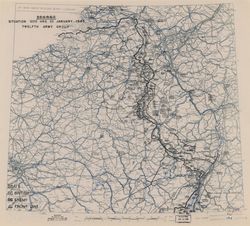
[January 22, 1945], HQ Twelfth Army Group situation map Map showing Western Allies and Axis troop position details in Western Europe as of approximately 1200 hours, January 22, 1945 World War II Military Situation Maps Collection Library of Congress |